
Claude Code in 2026: How AI Coding Agents Are Changing Software Development

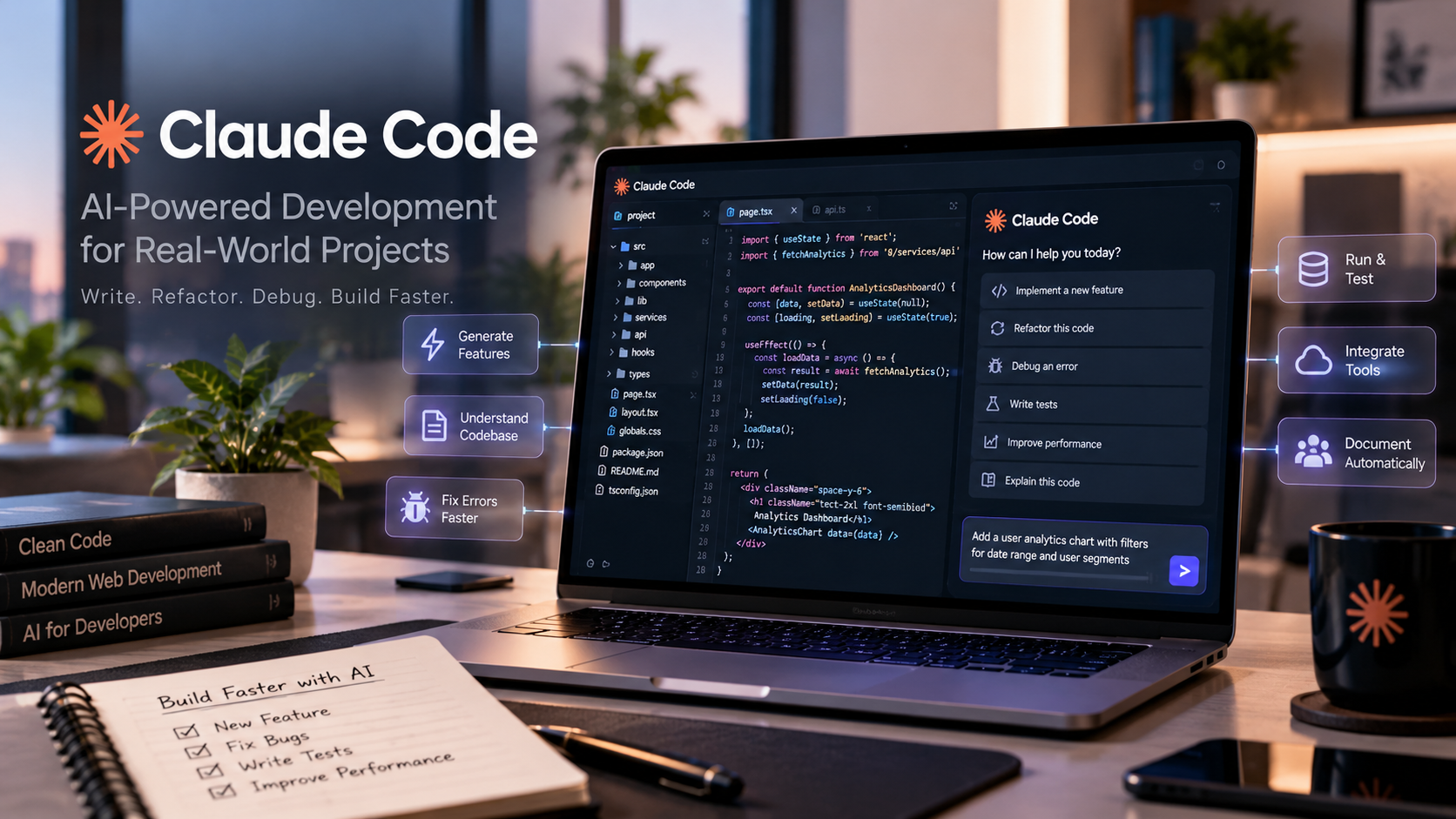
AI coding agents are changing how developers build, test, and maintain software. Discover how Claude Code works, where AI-assisted development offers real benefits, and what businesses should consider before adopting it.
Claude Code in 2026: How AI Coding Agents Are Changing Software Development
Software development is entering a new phase. AI tools are moving beyond code suggestions and autocomplete toward systems that can understand a codebase, work across multiple files, run commands, and assist with complex development tasks.
One of the tools attracting growing attention is Claude Code.
For startups, software teams, and businesses investing in digital products, the important question is no longer simply whether AI can write code. It is how AI can fit into a reliable software development process.
What Is Claude Code?#
Claude Code is an AI-powered coding tool designed to help developers work with existing codebases and perform development tasks through natural-language instructions.
Depending on the task and its permissions, developers can use it to:
- Understand unfamiliar repositories.
- Implement features across multiple files.
- Investigate errors and suggest fixes.
- Generate and run tests.
- Refactor existing code.
- Assist with documentation.
- Support repetitive development workflows.
Rather than manually explaining every file, a developer can ask the tool to investigate a problem, propose a solution, and help implement it.
However, generated code still needs review, testing, and appropriate security checks.
Why Are AI Coding Agents Becoming Important?#
The development process involves much more than writing individual functions. Developers spend considerable time understanding requirements, navigating existing code, debugging errors, testing changes, and maintaining software.
AI coding agents can assist across several of these activities.
For example, consider a SaaS application that needs a new reporting feature. An AI-assisted workflow might involve examining the database schema, identifying relevant API routes, implementing the feature, generating tests, and documenting the changes.
The developer remains responsible for architectural decisions, permissions, data integrity, and the final result.
Research published in October 2026 shows that Claude's relative Google search interest in India increased substantially over the preceding year. This provides a measurable signal of growing attention, although search interest alone does not establish how many people use Claude Code specifically.
Where Can Businesses Benefit?#
AI-assisted development can be particularly useful for:
Startup MVPs: Teams can explore product ideas and build initial prototypes more efficiently.
Legacy applications: Developers can use AI to understand unfamiliar code and investigate potential improvements.
Testing and maintenance: AI can assist with test generation, documentation, and repetitive engineering tasks.
Internal tools: Businesses can accelerate the development of dashboards, reporting systems, and workflow applications.
The potential benefit depends on the task, codebase, tooling, and quality of human oversight.
What Are the Risks?#
AI-generated code is not automatically production-ready.
Businesses should pay attention to:
- Security vulnerabilities and exposed credentials.
- Incorrect assumptions about existing architecture.
- Incomplete or misleading tests.
- Licensing and dependency considerations.
- Unreviewed database migrations.
- Uncontrolled access to production systems.
A reliable process uses version control, code review, automated testing, restricted permissions, and human approval for sensitive operations.
Can AI Replace Software Developers?#
AI can automate portions of development, but building a reliable product also requires requirements analysis, system architecture, user experience, integration design, security, deployment, and ongoing maintenance.
The more useful approach is to treat AI as a development capability rather than a replacement for engineering judgment.
Businesses that combine AI tools with sound engineering practices may be better positioned to build and improve software efficiently.
Build Smarter. Build with AI.#
AI is changing how software gets built. The real advantage comes from using it to create better products, automate workflows, and solve real business problems.
Have an idea worth building?
Let's turn it into reality.
Written by TeamRudrion
Verified AuthorWriter at Rudrion Infotech. Specializing in high-throughput cloud architectures, multi-tenant databases, and enterprise AI copilots.
Ready to engineer scalable software or enterprise AI copilots?
Book a direct technical architecture session with our principal engineers. We review your system design, scalability bottlenecks, and delivery roadmap.
Discussion (0)
No comments yet. Be the first to share your perspectives!
Leave a Comment
Share insights, ask architectural questions, or contribute to the discussion.