
Microsoft Layoffs 2026: 60,000 Employee Buyouts Explained

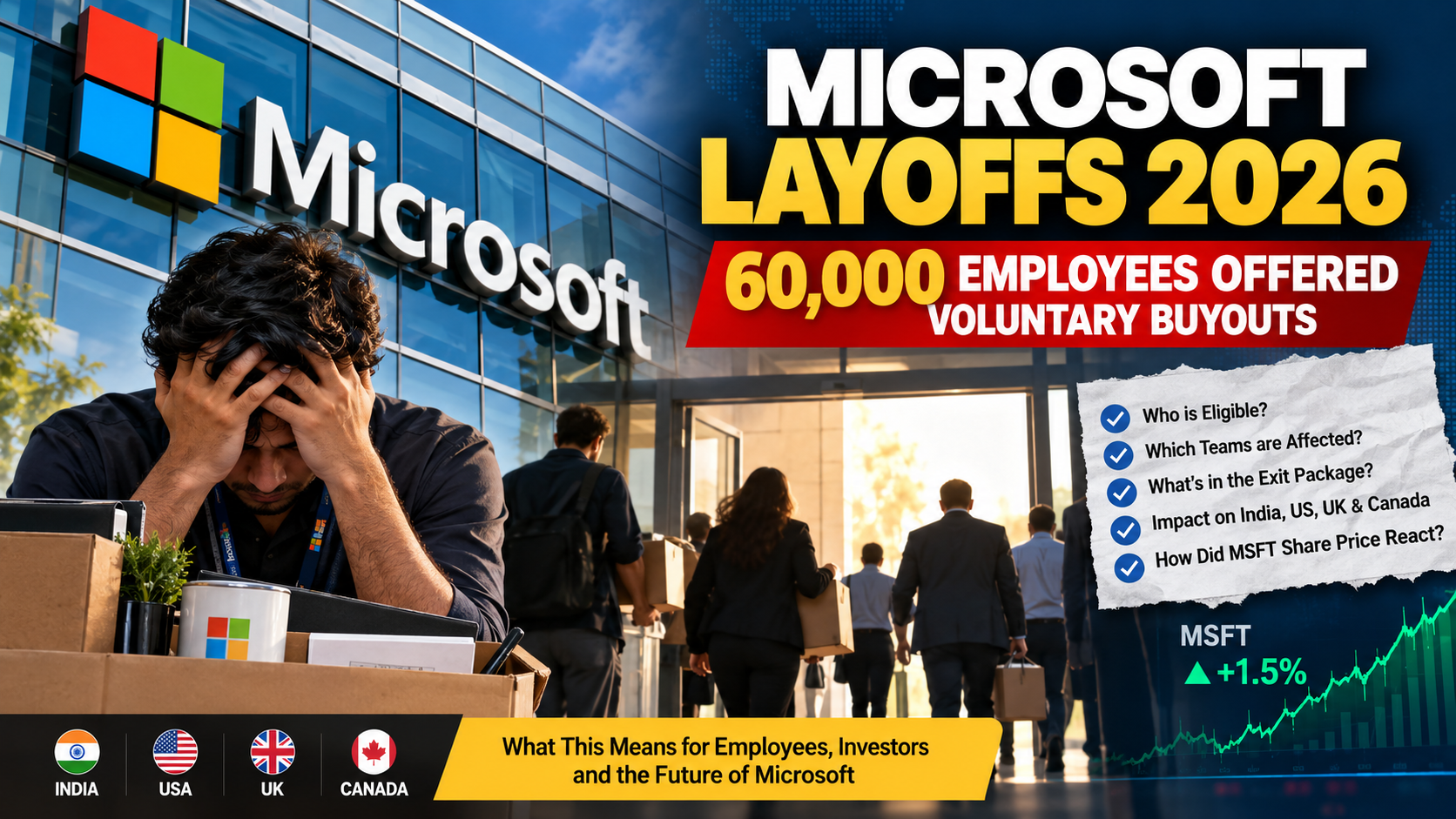
Is Microsoft preparing for a major workforce shake-up? Around 60,000 employees may be eligible for its new voluntary exit offer—but that doesn't mean 60,000 people are being laid off. From who qualifies and what the buyout could mean for employees to Microsoft's growing AI investments and MSFT share-price reaction, here's what you need to know about one of the biggest technology workforce stories of 2026.
Microsoft Layoffs 2026: 60,000 Employees Offered Voluntary Buyouts as AI Spending Surges
Microsoft news | Microsoft layoffs | Microsoft buyouts | MSFT share price
Published: October 27, 2026
Microsoft has announced a new Voluntary Exit Offer for eligible employees, putting the company's workforce strategy back in the spotlight. The initiative could affect approximately 60,000 employees across selected teams in India, the United States, the United Kingdom, and Canada.
But there is an important distinction: Microsoft has not announced that it is laying off all 60,000 employees. The figure refers to the approximate number of employees eligible for a voluntary exit offer, not the number confirmed to be leaving the company.
The announcement comes as Microsoft continues investing heavily in artificial intelligence (AI), cloud infrastructure, and data centres while adjusting its workforce to changing business priorities.
For employees, the offer raises questions about severance packages, eligibility, and future career decisions. For investors, it adds another development to watch as Microsoft balances AI investment with operating costs and long-term growth.
Here's what you need to know about the latest Microsoft layoffs news, the voluntary employee buyout programme, and the potential implications for Microsoft's business and share price.
What Is the Latest Microsoft Layoffs News?#
On October 26, 2026, Microsoft introduced a new Voluntary Exit Offer (VEO) for eligible employees in participating organisations.
According to Microsoft's official announcement, the programme gives eligible employees an opportunity to leave the company with financial support and career-planning resources. It also gives participating business units another way to adjust their workforce according to changing priorities.
The offer is available to eligible employees at internal level 70 and below in participating teams across four countries:
- India
- United States
- United Kingdom
- Canada
Microsoft had approximately 223,000 full-time employees globally as of June 2026. Reports indicate that around 60,000 employees could be eligible for the new programme, representing more than a quarter of the company's workforce.
However, eligibility does not mean that an employee must leave Microsoft. Participation is voluntary, and the company has not announced a target for how many employees it expects to accept the offer.
The programme is also limited to selected organisations rather than every employee within Microsoft.
The key takeaway: Microsoft's latest announcement concerns a voluntary employee exit programme, not a confirmed layoff of 60,000 people.
Source: Microsoft's official announcement | Reuters report
Microsoft Voluntary Employee Buyout: Who Is Eligible?#
One of the biggest questions surrounding the announcement is which employees can participate.
Microsoft says the Voluntary Exit Offer is available to eligible employees in participating teams in India, the United States, the United Kingdom, and Canada, at internal level 70 and below.
Eligibility depends on the employee's organisation and the specific terms communicated by Microsoft. Not every department is participating.
Which Microsoft Teams Could Be Included?#
Reports have identified several participating areas, including:
- AI experiences
- Microsoft Copilot
- Finance
- Human resources
- Xbox
- Windows + Devices
Other organisations, including marketing, commercial business, and security, have been reported as excluded from the programme. Participation can vary by team, so employees should rely on their official internal communication to confirm eligibility.
Microsoft has said that eligible employees will receive an email containing a link to their individual Voluntary Exit Offer details.
This distinction matters because the headline figure of 60,000 can make the programme appear broader than it is. The offer is available only to eligible employees within participating organisations.
Does the Programme Include Employees in India?#
Yes. India is one of the four countries included in Microsoft's announcement.
However, being employed in India does not automatically make every Microsoft employee eligible. The offer applies to eligible employees in participating teams, and the individual terms may vary by location and employment circumstances.
Employees should review their official offer documents before making a decision.
Microsoft Buyouts vs. Microsoft Layoffs: What's the Difference?#
The terms buyout, voluntary exit, and layoff are often used together in technology news, but they describe different employment situations.
What Is a Voluntary Employee Buyout?#
A voluntary employee buyout gives eligible employees the option to leave a company under an agreed exit arrangement, generally with financial support or severance benefits.
The employee decides whether to accept the offer, subject to the programme's terms.
For Microsoft, the Voluntary Exit Offer is designed to provide eligible employees with an alternative route to leaving the company while allowing participating organisations to adapt their workforce.
What Is a Layoff?#
A layoff is an employer-initiated reduction in employment. Unlike a voluntary buyout, an employee does not necessarily choose to leave.
Companies may announce layoffs when restructuring operations, reducing costs, eliminating roles, or changing business priorities.
The Key Differences#
| Feature | Voluntary Employee Buyout | Layoff |
|---|---|---|
| Who initiates the process? | The employer offers a programme, and eligible employees choose whether to participate. | The employer decides which roles or employees are affected. |
| Is participation voluntary? | Yes, under the programme's terms. | No, from the employee's perspective. |
| Financial support | May include severance and other benefits. | May include severance and other benefits. |
| Who is affected? | Employees who meet eligibility requirements and accept the offer. | Employees whose roles are selected for elimination. |
| Main purpose | Provide an alternative exit route and help adjust workforce needs. | Reduce or restructure the workforce. |
Voluntary Employee Buyout vs. Layoff
Microsoft's new programme is a voluntary exit offer. It should not be described as 60,000 confirmed layoffs.
Why Is Microsoft Offering Buyouts to Employees?#
Microsoft's announcement comes amid a period of substantial investment in artificial intelligence.
The company is spending heavily on data centres, computing infrastructure, chips, and the systems needed to support AI services. These investments are intended to support products and services across Microsoft's business, including cloud computing and Copilot.
Reuters reported that Microsoft forecast approximately $175 billion in capital expenditures for calendar year 2026, reflecting the scale of its infrastructure investment.
At the same time, major technology companies face pressure to demonstrate that their AI investments can generate sustainable financial returns.
This creates a difficult management challenge: companies need to invest in future growth while keeping operating costs under control.
Microsoft's voluntary exit programme may help participating teams adjust their workforce and manage costs. However, the company has not publicly stated a specific savings target or a target number of employees expected to accept the offer.
Several factors may help explain the broader context.
1. Rising AI Infrastructure Costs#
Building and operating AI infrastructure requires substantial investment in computing equipment, data centres, networking, and electricity.
Microsoft is expanding its AI capabilities, and infrastructure spending is a major part of that strategy.
2. Changing Workforce Requirements#
As technology and business priorities evolve, companies may need different combinations of skills and expertise.
Microsoft has said that the programme will allow participating organisations to adapt their workforce to changing needs. That does not, by itself, establish that AI is directly replacing every role covered by the offer.
3. Pressure to Balance Growth and Costs#
Investors want technology companies to grow, but they also evaluate how efficiently companies use their resources.
Voluntary exit programmes can provide another way to manage staffing costs while giving employees a choice about their next career step.
4. A Broader Workforce Restructuring Strategy#
Microsoft's latest offer follows other workforce changes announced during 2026.
Earlier this year, the company introduced a voluntary retirement programme for eligible US employees. In July, Microsoft also announced approximately 4,800 job cuts, including changes affecting its Xbox gaming business.
The new offer is another development in Microsoft's ongoing workforce adjustments, although it does not establish how many employees will ultimately leave.
Microsoft Voluntary Exit Offer: What Could Employees Receive?#
Another major question concerns the financial package available to employees who accept the offer.
Microsoft has said the programme includes financial support and career-planning resources. Reports indicate that the package is expected to follow Microsoft's standard severance arrangements, but individual terms depend on the employee and applicable programme rules.
Potential elements reported for the programme include:
- Severance based on applicable employment terms
- Continued stock vesting for a specified period, where applicable
- Health coverage for a defined period
- Career transition support
These details should not be interpreted as a guarantee that every employee will receive identical benefits.
The exact package can depend on factors such as the employee's location, internal level, tenure, and the terms set out in the individual offer.
When Must Employees Decide?#
Reports indicate that eligible employees will have until early December 2026 to decide whether to accept the offer, with departures expected at the end of December.
Employees should check their official Microsoft communications for the exact deadline, payment terms, benefits, and departure arrangements that apply to them.
Should Employees Accept a Voluntary Buyout?#
There is no universal answer.
An employee considering a voluntary exit should evaluate several factors before making a decision:
Financial security: Calculate how long the financial package and existing savings could cover living expenses.
Future employment: Assess the availability of alternative roles and the time that may be required to find another position.
Benefits and equity: Understand the impact on healthcare coverage, unvested stock, bonuses, and other compensation.
Career direction: Consider whether leaving creates a useful opportunity to pursue a different role, industry, or professional goal.
Individual circumstances: Review family commitments, financial obligations, and personal career priorities.
A voluntary exit package can be useful for some employees and unsuitable for others. The decision should be based on the actual written offer rather than headlines or speculation.
Microsoft 60000 Buyouts: Will All Eligible Employees Leave?#
No. The number of eligible employees is not the same as the number of employees expected to accept an offer.
Microsoft has not announced how many employees it expects to leave through the new programme.
Employee participation will likely depend on the terms offered, individual career plans, financial considerations, and opportunities elsewhere.
A programme that makes 60,000 employees eligible could ultimately result in substantially fewer departures.
It is also important not to assume that Microsoft intends to eliminate every position held by an eligible employee. The programme allows eligible employees to choose whether to leave, while participating organisations continue to determine their workforce needs.
For this reason, headlines suggesting that Microsoft is laying off 60,000 employees would be misleading.
The accurate description is that Microsoft has introduced a voluntary exit offer potentially available to approximately 60,000 employees.
How Does This Fit Into Microsoft's Earlier Layoffs?#
The new voluntary exit programme follows a series of workforce changes at Microsoft.
Earlier in 2026, Microsoft offered a voluntary retirement programme to eligible employees in the United States. Reports indicated that approximately 9,000 employees were eligible for that earlier offer.
In July, Microsoft announced approximately 4,800 job cuts as part of changes to its Xbox gaming business and broader efforts to improve returns from the division.
Those earlier measures are separate from the new October voluntary exit offer.
The sequence highlights Microsoft's continuing effort to adjust staffing and organisational priorities while investing in AI and other areas of its business.
However, the programmes should not be combined into one figure without distinguishing between employees who were eligible for buyouts, employees who accepted voluntary exits, and employees whose positions were eliminated through layoffs.
These are different categories, and confusing them can exaggerate the number of confirmed job losses.
Microsoft Share Price: How Did Investors React?#
Microsoft's workforce announcement also attracted attention from investors monitoring the company's financial performance.
Microsoft trades on the Nasdaq under the ticker symbol MSFT.
According to Reuters, Microsoft's shares rose approximately 1% on October 26, 2026, following the announcement. Other market data showed a gain of approximately 1.5% for the regular trading session that day.
The share-price movement provides useful context, but it does not establish that the buyout announcement alone caused the increase.
Stock prices respond to many factors, including earnings expectations, market conditions, interest rates, cloud growth, AI demand, and company-specific developments.
Why Does Microsoft's Workforce Strategy Matter to Investors?#
Investors may evaluate workforce changes through several questions.
Can Microsoft manage costs while continuing to grow?
Reducing staffing costs may improve operating efficiency, but the effect depends on severance expenses, the roles affected, and the company's overall financial performance.
Will AI investments generate sufficient returns?
Microsoft is committing substantial resources to AI infrastructure. Investors will continue evaluating whether demand and revenue growth justify those investments.
Could restructuring affect business performance?
Workforce reductions can lower costs, but companies must also retain the skills and experience required to develop products, support customers, and operate critical systems.
What do upcoming earnings reveal?
Quarterly results can provide information about revenue growth, operating margins, cloud performance, and investment spending. These indicators may matter more to investors than any single workforce announcement.
Is Microsoft Stock a Buy After the Buyout News?#
The announcement alone is not enough to determine whether MSFT is a good investment.
Investors should examine Microsoft's current valuation, financial results, cash flow, AI spending, cloud growth, and longer-term business outlook before making an investment decision.
The share price can move in either direction, and past performance does not guarantee future returns.
This article provides general news and business information, not investment advice.
What Microsoft's Buyout Programme Could Mean for the Technology Industry#
Microsoft's latest announcement reflects a wider challenge facing large technology companies: how to organise their workforce while investing in rapidly developing technologies.
AI is creating new opportunities in software development, cloud computing, automation, data infrastructure, and enterprise services. At the same time, companies are evaluating how AI changes existing workflows and the skills required to operate their businesses.
However, it would be inaccurate to conclude that every workforce reduction in the technology sector is caused by AI.
Companies make staffing decisions for multiple reasons, including restructuring, product strategy, changing demand, cost management, and business performance.
Microsoft's programme illustrates how a company can use voluntary exits as one tool for workforce planning while continuing to invest in future technologies.
The longer-term impact will depend on how many employees accept the offer, how Microsoft reallocates resources, and whether its investments translate into sustainable business growth.
What Happens Next in the Microsoft Layoffs Story?#
Several developments will help clarify the impact of Microsoft's latest announcement.
Employee participation: The number of employees who accept the voluntary exit offer will help determine the programme's effect on Microsoft's workforce.
Programme details: Individual offer terms and the applicable deadlines will determine how eligible employees evaluate their options.
Quarterly earnings: Microsoft's financial results and management commentary will provide further information about AI investment, operating costs, and business performance.
Future workforce decisions: The company may continue adjusting teams and priorities as business requirements evolve. However, the latest announcement does not establish a specific future layoff target.
For now, the most important distinction remains unchanged: approximately 60,000 employees may be eligible for the voluntary exit offer, but the number who will actually leave is not yet known.
Frequently Asked Questions About Microsoft Layoffs#
1. Is Microsoft laying off 60,000 employees in 2026?#
No. Microsoft has introduced a voluntary exit offer that could be available to approximately 60,000 eligible employees. That figure represents eligibility, not 60,000 confirmed layoffs or departures.
2. What is Microsoft's voluntary employee buyout programme?#
The Voluntary Exit Offer is a time-limited programme that allows eligible employees in participating organisations to leave Microsoft with financial support and career-planning resources. Participation is voluntary and subject to individual eligibility and offer terms.
3. Are Microsoft employees in India eligible for the buyout?#
Yes. India is one of the four countries included in the programme, alongside the United States, the United Kingdom, and Canada. Eligibility depends on the employee's team and internal level.
4. Which Microsoft departments are included in the offer?#
Reports identify AI experiences, Copilot, finance, human resources, Xbox, and Windows + Devices among the participating areas. Not every team is included, and employees should confirm their eligibility through official company communications.
5. How much severance will Microsoft employees receive?#
Microsoft has not published one universal payment amount for every eligible employee. Reports indicate that packages follow standard severance arrangements, with terms depending on factors such as location, level, and tenure. Employees should consult their individual offer documents.
6. Why is Microsoft offering voluntary buyouts?#
The offer gives eligible employees an alternative to remaining with the company and gives participating organisations another way to adjust their workforce. The announcement comes as Microsoft invests heavily in AI infrastructure and manages changing business priorities.
7. Did Microsoft announce additional layoffs with the new offer?#
The October 26 announcement concerned a voluntary exit programme. It should not be interpreted as a simultaneous announcement that 60,000 jobs are being eliminated. Future staffing decisions remain separate from the number of employees eligible for this offer.
8. What is Microsoft's stock ticker?#
Microsoft trades on the Nasdaq under the ticker symbol MSFT.
9. Did Microsoft's share price fall after the buyout announcement?#
Reuters reported that Microsoft shares rose approximately 1% on October 26, 2026. The movement reflects trading during that session and does not establish that the buyout announcement alone caused the change.
10. Where can I find official information about the voluntary exit offer?#
Microsoft published its announcement on the official Microsoft Blog. Employees should use their internal company communications for individual eligibility, benefits, and deadlines.
Official source: https://blogs.microsoft.com/blog/2026/10/26/introducing-a-voluntary-exit-offer/
Final Thoughts: Microsoft Buyouts Highlight a Changing Technology Workforce#
Microsoft's new voluntary exit offer is a significant workforce development, but the headline figure needs context.
Approximately 60,000 employees may be eligible to participate. The programme does not mean that all 60,000 will leave, and Microsoft has not announced how many employees it expects to accept the offer.
The announcement comes as the company continues investing heavily in AI infrastructure while adapting its workforce to changing business priorities.
For employees, the immediate priority is understanding the individual offer and evaluating its financial and career implications. For investors, the key questions concern Microsoft's AI spending, operating efficiency, cloud growth, and ability to generate sustainable returns.
The next stage of the story will depend on employee participation and Microsoft's broader business performance—not simply the number of people eligible for a voluntary exit.
Stay informed about Microsoft layoffs, technology industry developments, AI investment, and market news through Rudrion InfoTech.
Read more technology and business updates: Rudrion InfoTech
Written by TeamRudrion
Verified AuthorWriter at Rudrion Infotech. Specializing in high-throughput cloud architectures, multi-tenant databases, and enterprise AI copilots.
Ready to engineer scalable software or enterprise AI copilots?
Book a direct technical architecture session with our principal engineers. We review your system design, scalability bottlenecks, and delivery roadmap.
Discussion (0)
No comments yet. Be the first to share your perspectives!
Leave a Comment
Share insights, ask architectural questions, or contribute to the discussion.